Case Title
Nadia Kanwal vs. The Chancellor, University of Sargodha / Governor of Punjab & another
Date of Hearing
19 January 2026
Bench
Hon’ble Mr. Justice Muhammad Sajid Mehmood Sethi
Lahore High Court
Background of the Case
The petitioner, Ms. Nadia Kanwal, a Case Analyst (BPS-17) appointed in the year 2007 against a regular post in the University of Sargodha, approached the Lahore High Court after suffering serious financial and service-related prejudice despite her complete exoneration in departmental proceedings.
An inquiry was initiated against her in July 2021 on allegations of willful absence from duty. The petitioner consistently maintained that her absence was due to exceptional and unavoidable circumstances, including:
- Lawful relocation owing to her spouse’s transfer
- Formal requests for deputation
- Nationwide COVID-19 lockdowns
- Official directions of limited staff attendance
- Prolonged illness due to COVID-19
- Procedural delays at departmental and appellate forums
Despite submitting a detailed reply and remaining in continuous communication with the University, she was removed from service through a major penalty order dated 05.12.2023 under the PEEDA Act, 2006.
Exoneration and Reinstatement
Upon appeal, the competent appellate authority, after granting personal hearing and examining the entire record, categorically exonerated the petitioner of all charges on 06.12.2024, holding that:
- Her absence was not willful
- No misconduct or inefficiency was established
- The allegations could not be sustained
Consequently, she was reinstated in service vide order dated 23.12.2024.
However, the University treated the entire intervening period from 01.04.2020 to 16.12.2024 as Extraordinary Leave without pay, depriving her of salary, continuity of service, and attendant benefits—despite her unconditional exoneration.
Legal Issue Before the Court
The narrow but significant question before the Hon’ble Court was:
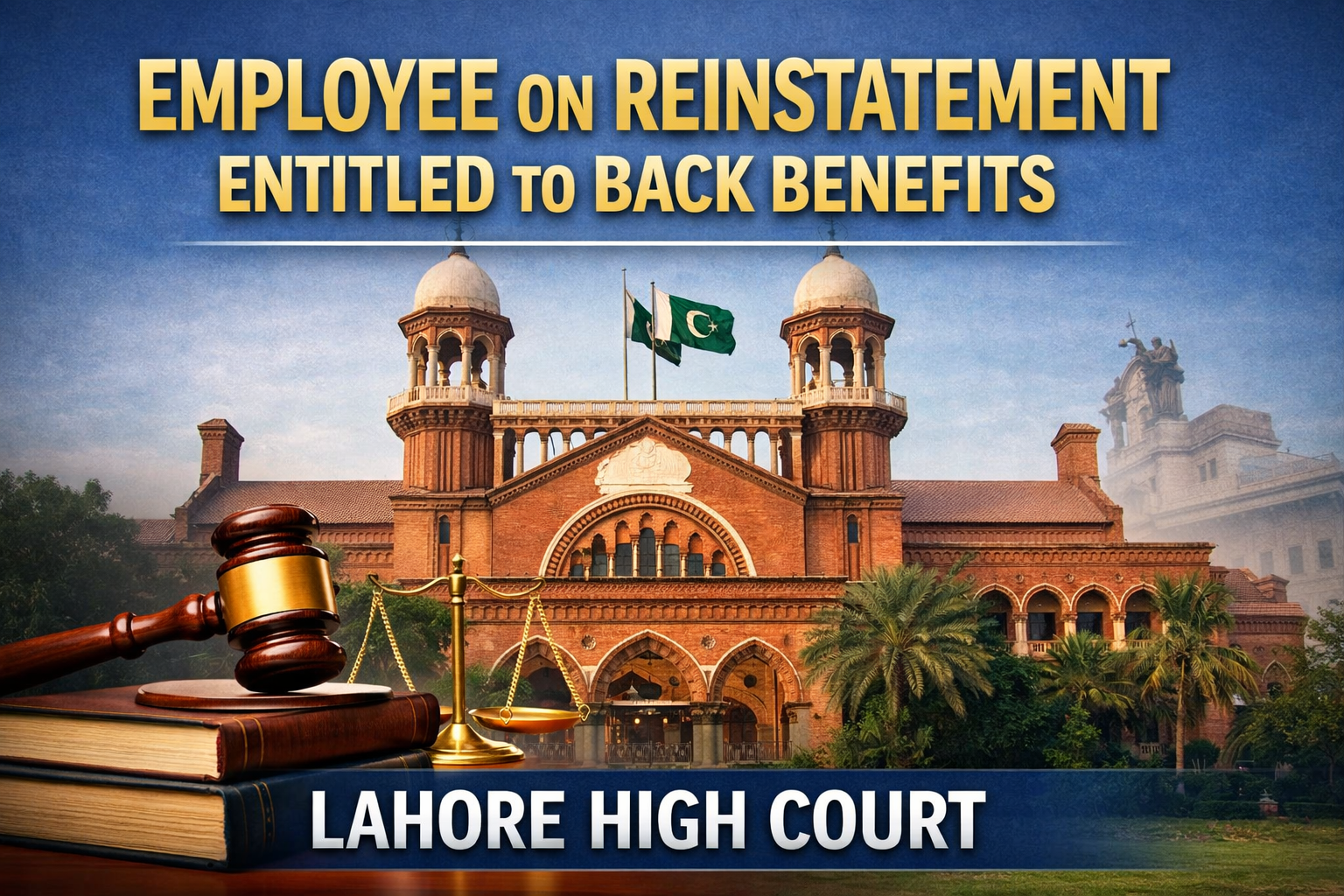
Whether an employee who is unconditionally exonerated and reinstated can lawfully be denied back benefits by treating the intervening period as unpaid leave?
Findings of the Lahore High Court
The Hon’ble Court answered the question in the negative, holding that:
- Unconditional reinstatement carries with it the right to continuity of service and back benefits
- Denial of such benefits is an exception, permissible only if the employee was gainfully employed elsewhere, which was not the case here
- Treating the intervening period as unpaid leave after full exoneration is illegal, unjust, and violative of settled principles of law
The Court relied upon authoritative judgments of the Hon’ble Supreme Court, including:
- Umer Said v. District Education Officer (Female) (2007 SCMR 296)
- Chairman, State Life Insurance Corporation v. Siddiq Akbar (2013 SCMR 752)
- Inspector General of Police, Punjab v. Turig Mahmood (2015 SCMR 77)
- Muhammad Sharif v. Inspector General of Police, Punjab (2021 SCMR 962)
The Court reaffirmed that grant of back benefits is the rule, while denial is a rare exception, strictly subject to proof of gainful employment.
Final Order
The Hon’ble Lahore High Court:
- Set aside the impugned orders dated 06.12.2024 and 23.12.2024 to the extent they treated the intervening period as Extraordinary Leave without pay
- Ordered submission of a compliance report before the Court
Significance of the Judgment
This judgment is another important reaffirmation of service jurisprudence in Pakistan, emphasizing that:
- Exoneration must restore dignity, service continuity, and financial rights
- Departments cannot indirectly punish employees after losing departmental or judicial scrutiny
- Arbitrary treatment of service periods undermines fairness, equity, and due process
Appreciation of Counsel for the Petitioner
The outcome of this case reflects meticulous advocacy and sound legal strategy by Mr. Allah Nawaz Khosa, Advocate High Court, who represented the petitioner.
Through precise articulation of facts, correct invocation of binding Supreme Court precedents, and focused argumentation limited to the real legal controversy, learned counsel successfully demonstrated that denial of back benefits after unconditional exoneration was legally indefensible.
His efforts ensured that the case remained anchored in settled principles of service law, enabling the Court to deliver a reasoned and impactful judgment protecting the rights of a public servant wrongfully deprived of her lawful benefits.
Conclusion
This judgment will serve as a guiding precedent for universities, autonomous bodies, and government departments, reinforcing that justice does not end at reinstatement alone—it must also include restoration of all lawful service benefits.